Ancestry Collaboration Tools
ROLE
Product designer
TIMELINE
June 2022 - July 2023
TEAM
2 Designer,
1 Product Manager
4 Engineers
Work
PROBLEM
What if family history wasn’t something you did alone?
Ancestry helped millions connect with their past - but back in 2022, it wasn’t helping them connect with each other on the platform. It was a Solo activity
Built to connect
Over a third of users joined Ancestry to connect with relatives (36%)
Meant to share
Nearly two in five users wanted to share their discoveries (38%)
Momentum faded
Without collaboration, users ran out of things to do and disengaged (19%)
GOAL
Make it a family experience
Transform family history from a solo task into a shared, connected experience where families can build, discover, and engage together. Multi-user engagement drives richer trees, stronger emotional ties, higher retention, and organic growth through family invites.
What Success Looks Like:
- A grandmother inviting her kids to help building the tree
- Cousins messaging each other above discoveries
- Families returning - not just for new hints but new memories
SOLUTION
Newest ways to collaborate.
Start a new message group about a specific question, share interesting records, ask for help, swap tips, discuss intriguing hints, and easily keep track of everything all within Ancestry®.

Ancestry® Circles (Groups)
A new way for families to stay connected and collaborate more easily within the platform.

Tree Collaboration Tools
Invite family to explore your tree and even contribute their own suggestions. Choose where they can help, and decide what makes it into your tree.

Sharing and Messaging
Now you can reach out to a family member, even if they're not on Ancestry®, for help on a specific ancestor.
CORE FLOWS
Ancestry Groups
A new way for families to stay connected and collaborate more easily within the platform.
Tree Collaboration Tools
Build family trees together with more transparency and shared access.
Sharing and Messaging
Communicate with relatives, friends directly within Ancestry.
RESEARCH
Researching platforms where collaboration already works
Learning from platforms like Splitwise, Life360, Apple Photos, and Google Photos and how they make collaboration feel familiar, safe, and easy to sustain over time.

EXPLORING FAMILY SPACES
Solo to Collaborative space
We explored what collaboration could look like on Ancestry, spanning real-time participation, shared family spaces, and lightweight ways to contribute together.

DESIGN JOURNEY
Family Groups
Family Groups made Ancestry more family-first by enabling users to create flexible, emotionally meaningful networks beyond the tree, reusable across collaborative features.
Reduces coordination friction
Groups transform solo discovery into collective progress making trees, photos, and messages immediately relevant to more people.
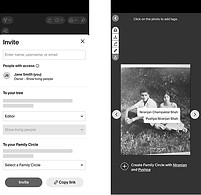
Create durable shared context
A group becomes the living container for a family’s activity, reducing repetition, confusion, and fragmented knowledge.

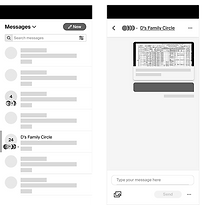
Enables faster engagement loops
Groups act as fast paths to messages, trees, and recent activity, increasing frequency and depth of interaction.
Testing and iterating with feedback!


KEY USER INSIGHTS
Value clarity was missing
Creators didn’t immediately understand why Family Groups mattered or how they differed from a social feed.
Onboarding lacked context
Creators and invitees needed clearer framing before committing to create or join a group.
Trust and access concerns
Uncertainty around invites, naming, and paywalls made users hesitant to move forward.
WHERE WE LANDED
Onboarding to Family Group
Designing for an experience that will show users how groups work and the immediate value of collaboration.
Family Group Invitee Flow
Easy lightweight design for the invitee flow to get them on Family Groups.
REFLECTION
What I learned....
Trust before collaboration
Users need clarity and control over what they’re sharing and with whom in order to feel comfortable engaging even with family members.
Familiar patterns win
Drawing on patterns from platforms like Facebook helped reduce the learning curve, especially for older users who were hesitant to try something new.
Emotion drives retention
Users saw comments, reactions, and edits from loved ones, it transformed static family history into a shared, living experience making them more likely to return and contribute again.
Role